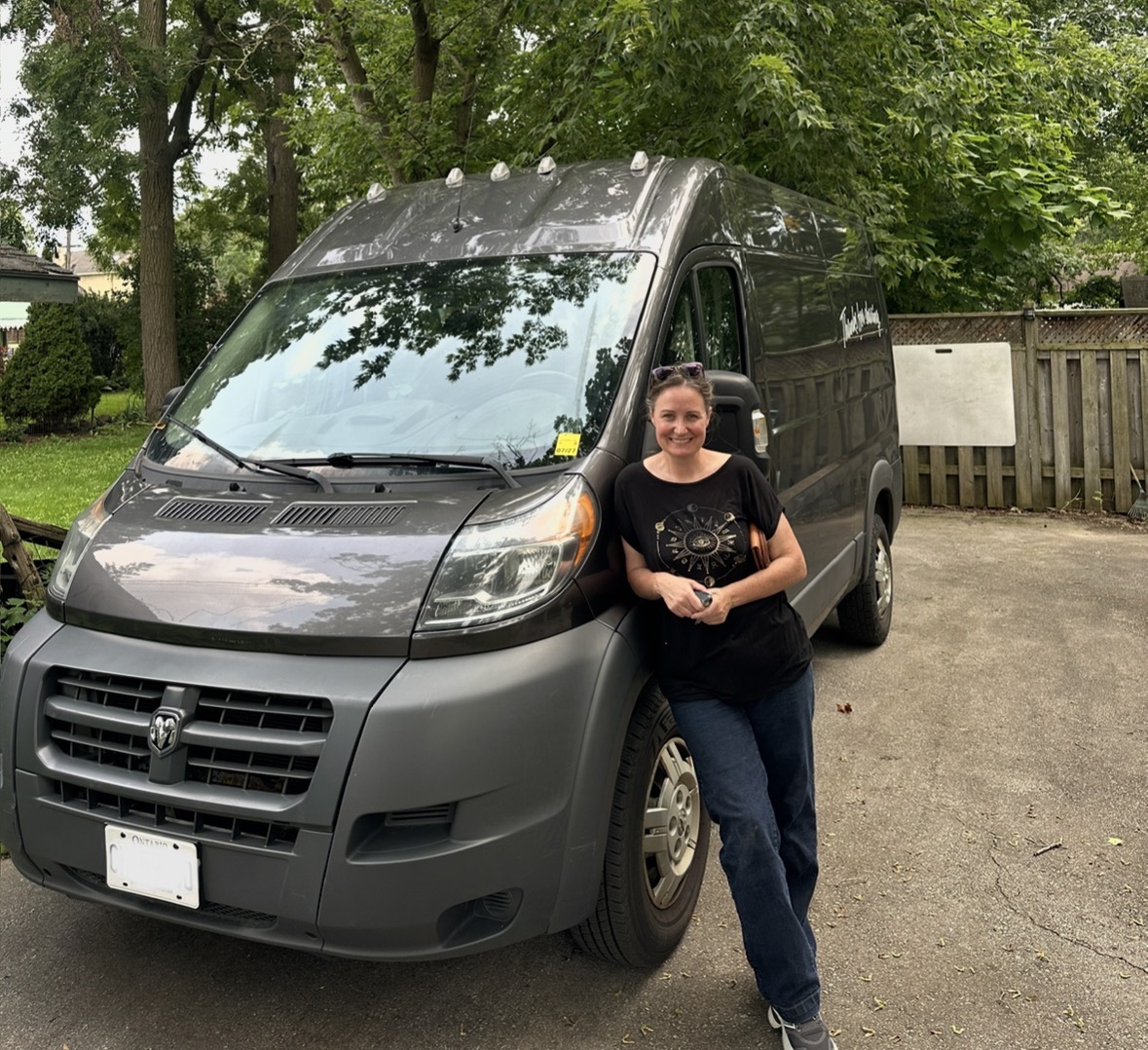
When you’re a chronically creative person, joy often lives in the thing you haven’t tried yet — which is how I ended up buying an old cargo van to turn into a weaving studio on wheels.
For a bit of context, weaving and fibre arts have been a really important part of my life for the last ten years and I even pursued it full time for a spell. As a single income household, it was tough to rely on that income to live off of and at the time, I was only selling my weaving at craft shows and online. So, weaving went back to happening on the side as I work a busy 9-to-5 job. I love my professional career too, so I am always working to find balance between purpose, creativity, and joy.
The challenge is, after a long week or long work day, I don’t always have capacity to set up a loom. If I already have a project on there, I love to work away at it… but the time it takes to measure a warp, wind it on a loom, thread the heddles, slay the reed, tie the knots, and get started, can feel very overwhelming.
Often I default to my spinning wheel when I don’t have a project on the loom and I’ve been increasingly camping with my spinning wheel so I can get out of my home where I’m distracted by chores, responsibilities, doom scrolling, etc. There is simply nothing better than being offline, in nature, and creating.
That’s the feeling I want to be able to take with me anywhere. My vision for the van is a simple, open-concept build: room to work on my smaller Saori loom and my spinning wheel, a four-season setup with a simple water and electrical system run off a power station, and two beds so my son — or anyone who wants to tag along — can come on trips. Inspiring decor that keeps me feeling creative.
But my vision for the actual van project is so much more.
Across Canada, farms, fibre mills (those that are left), spinners, dyers, and yarn sellers have formed an ecosystem to preserve and sustain fibre arts. From fleece to yarn, there are incredible stories of people that want to preserve the traditions of wool and fibre production and keep alive an industry that has largely been automated and commercialized. There are also fibre artists like me, who want to buy Canadian products and support this important supply chain through our work.
I want my van to help sustain (and hopefully grow) this industry in Canada. I want to travel to sheep farms, alpaca farms, woollen mills, fibre businesses, artist’s studios, and more, and share these stories. I’m passionate about the legacy of crafts like weaving and spinning and I want to inspire others to learn them as well.
If we don’t have farms, we don’t have wool. If we don’t have mills, we can’t process the wool and it goes to waste. If mills don’t have customers, they can’t sell Canadian products.
If that’s a world you want to be part of — whether you’re a farmer, a mill owner, a dyer, a fellow fibre artist, or just someone with a spot to park a van — I’d love to hear from you. I want to visit as many places as I can on these travels, and I’ll be sharing the whole journey here as I go. All I need is a spot to park 🙂